Awards › Guides › Logging skills
Logging skills
Portion Sizes Without a Scale: Using Your Hand and Everyday Objects
You do not need a kitchen scale to track food reasonably well. Your hand is a portable guide: a palm for protein, a fist for a cup, a cupped hand for snacks and a thumb for fats. Measure a few dense foods once to calibrate your eye, and estimate the rest.
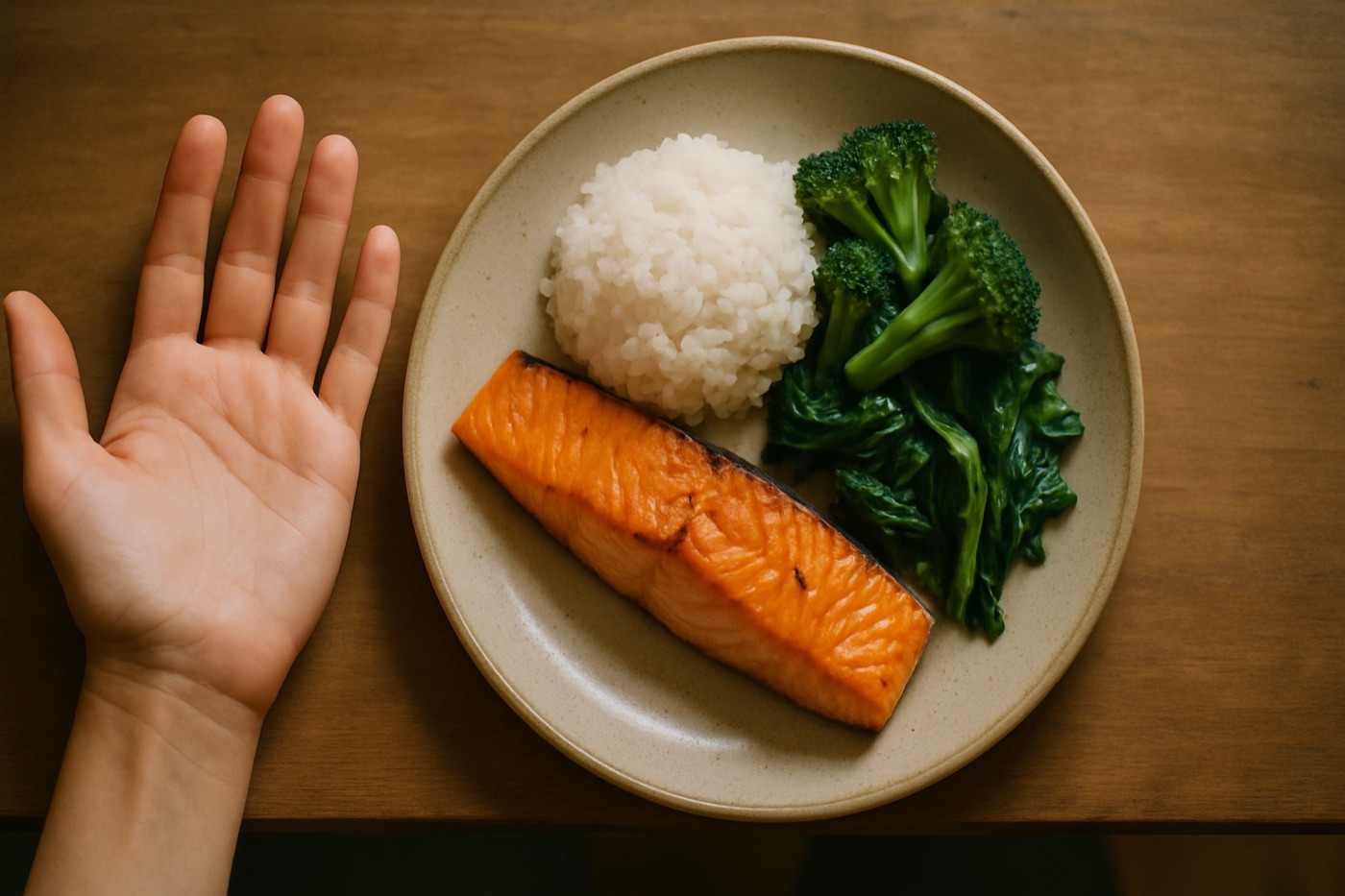
A kitchen scale is the most precise way to track food, but most meals do not happen next to one. Lunch at work, dinner at a friend’s, snacks on the go: in all of them, estimating is the only option. With a little practice, estimates can be good enough to make a diary useful.
Your hand as a measuring tool
Hands vary, but they scale roughly with body size, and you always have one with you.
| Hand measure | Roughly equals | Use it for |
|---|---|---|
| Palm (thickness and size, no fingers) | 85–115 g cooked meat or fish | Chicken, steak, fish, tofu |
| Fist | About 1 cup | Rice, pasta, cereal, fruit, vegetables |
| Cupped hand | About ½ cup, or a small handful | Nuts, dried fruit, snacks |
| Thumb (tip to base) | About 1 tablespoon | Peanut butter, oil, butter, dressings |
| Thumb tip | About 1 teaspoon | Butter on toast, oil drizzles |
These are approximations. They are useful because they are consistent: if you always estimate the same way, your diary will show trends accurately even if individual numbers are a little off.
Everyday objects
Some people find objects easier to picture than hands:
- A deck of cards: a portion of cooked meat, about 85 g.
- A tennis ball: a cup of fruit or a medium piece of fruit.
- A golf ball: about two tablespoons of nut butter.
- A pair of dice: about 30 g of hard cheese.
- A computer mouse: a medium baked potato.
Calibrate once
The fastest way to get good at estimating is to measure for a short time. If you can borrow a scale or measuring cups for a week or two, weigh the foods you eat most often and compare them with your guesses. Most people discover two things: they underestimate dense foods and overestimate vegetables. After that, estimates improve a lot.
Where estimates matter and where they do not
| Food type | Calories per tablespoon or handful | How careful to be |
|---|---|---|
| Oils and butter | High (about 100–120 per tablespoon) | Very careful |
| Nuts, seeds, nut butters | High | Careful |
| Cheese | High | Careful |
| Cereal, granola | Medium to high | Careful |
| Cooked grains, potatoes | Medium | Moderately careful |
| Lean meat and fish | Medium | Moderately careful |
| Fruit | Low to medium | Relaxed |
| Vegetables (not fried) | Low | Relaxed |
A heaped spoonful of peanut butter instead of a level one can add 50 to 100 calories. An extra handful of spinach adds almost nothing. Put your attention where the calories are.
Simple habits that help
- Use the same bowls and glasses at home. Once you know your cereal bowl holds about a cup and a half when full, you never need to measure it again.
- Pour oil from a spoon, not the bottle.
- Serve snacks into a bowl instead of eating from the packet.
- Read the packet weight. Half a 200 g pack is 100 g.
Photos as a backup
If your app offers photo logging, it can estimate portions for you. It is still worth checking the result against your own sense of size, especially for oils and sauces that a camera cannot see.
The bottom line
Estimates are fine. Make them consistent, take care with dense foods, and calibrate your eye once with a scale or measuring cups if you can.
Quick answers
How can I measure food without a scale?
Use your hand as a guide: a palm-sized piece of cooked meat or fish is about 85 to 115 g, a fist is about a cup, a cupped hand is about a small handful of nuts or a half cup, and the tip of your thumb to the first knuckle is about a tablespoon.
Is it worth buying a food scale?
For a couple of weeks, it is the fastest way to calibrate your eye. Many people weigh their dense foods (oil, nut butter, cheese, cereal) for a fortnight and then estimate confidently afterwards.
Which foods should I measure most carefully?
The calorie-dense ones: oils, butter, nut butters, nuts, cheese, granola and cereal. Small errors there add up quickly, while vegetables make little difference.